The RFP response process determines 30-40% of enterprise revenue for B2B companies, yet most teams treat it like a fire drill. The result? Suboptimal win rates, burnout, and missed deadlines.
We've lived this, and we've seen both sides: the chaos of manual processes and the transformation that comes from getting strategic about it. This guide shares everything we've learned about building a repeatable, winning RFP response process from the initial go/no-go decision through post-mortem analysis. You'll learn the 7-step framework that disciplined teams use, the common pitfalls that sink responses, and how modern AI automation can eliminate 80% of the manual work while improving quality.
Let's turn your RFP process from a bottleneck into a competitive advantage.
Definition: What is the RFP response process?
The RFP response process is a repeatable, structured workflow that guides teams from initial RFP intake through final submission and post-mortem analysis. It defines who does what, when, and how to ensure winning proposals are delivered on time.
Think of it as your playbook. Without it, every RFP is a scramble. With it, you're executing a proven system.
A formal RFP has three characteristics that distinguish it from a simple quote request:
- Structured format: Questionnaires, requirements matrices, and weighted evaluation criteria
- Standardized evaluation process: Multiple stakeholders scoring your response against published criteria
- Defined submission protocol: Specific deadlines, file formats, and delivery methods
The difference between an RFP and a sales conversation is like the difference between playing jazz and playing classical music. In jazz (sales), you improvise and adapt in real-time. In classical music (RFPs), you're being judged against a fixed score. You need precision, not just creativity.
Why most RFP response processes fail
I've watched smart teams with great products lose winnable deals because their process was broken. Here are the four failure modes I see most often.
Failure mode 1: Lack of go/no-go framework
Teams say yes to every RFP that lands in their inbox. The result? Resources spread so thin that every response is mediocre. One of our customers implemented a go/no-go framework using Realm's RFP Qualification AI Agent and saw their win rate climb. Same team, same product, but focused firepower.
Failure mode #2: Document assembly mindset
Teams treat RFPs as a compliance exercise: "Let's answer all the questions and check the boxes." Compliance gets you into the game. Storytelling wins the game.
Failure mode #3: Knowledge silos
Critical answers are trapped in email threads, outdated SharePoint folders, or SMEs' heads. Every RFP requires SMEs to hunt for this information from scratch, wasting valuable time.
Failure mode #4: No process owner
When everyone is responsible, no one is accountable. This leads to coordination chaos, missed assignments, and last-minute panic.
7-step RFP response process flow
1. Intake and qualification
Common pitfall is to respond to every RFP you intake. We push back with data: "A 'no' today protects capacity for a winnable deal tomorrow. Would you rather respond to 10 RFPs and win 2, or respond to 4 RFPs and win 2?"
The way to do this is to implement a go/no-go framework (also known as bid/no-bid framework). A winning frameworks evaluate opportunities across six critical dimensions to inform the decision:
- Strategic fit: Does this opportunity advance your business goals?
- Win probability: What are our realistic chances of winning?
- Relationship strenght: What is the depth and quality of your connection with the buyer?
- Capability and experience: Can you actually deliver what they're asking for?
- Resource availability: Can we do this without breaking our team or jeopardizing other commitments?
- Financial viability: Is the deal worth the effort?
To dive deeper into how to...
2. Kickoff and team assembly
The goal: Align stakeholders, assign accountability, and build a shared battle plan.
Once you've decided to go, momentum is everything. I've seen teams lose a week of critical time because they delayed the kickoff meeting, and by the time everyone aligned, the deadline pressure had eliminated any chance of strategic thinking.
Assign a single Proposal Manager/Owner. This person is the central nervous system. They own the timeline, coordinate SMEs, and are ultimately accountable for submission quality.
Define explicit roles: Proposal Manager, SMEs (Subject Matter Experts), Sales/Account Executive, Legal/Security, and Editor/Reviewer. Vague role definitions are where coordination fails.
The Kickoff Meeting Agenda: Review weighted evaluation criteria, identify buyer pain points, define 2-3 win themes, and establish the content plan.
Best practice: Schedule the kickoff within 48 hours of the Go decision. Waiting a week means you've lost 33% of a 3-week timeline before you've written a word.
Common pitfall: Assuming everyone knows their role. We once had an SME spend three days drafting a section that the Proposal Manager thought Legal was handling. Be explicit.
Step 3: Deconstruct the RFP and build your compliance matrix (The map that prevents disqualification)
The goal: Understand every requirement before writing a single word.
I once watched a team get disqualified from a $600K deal because they submitted a Word doc when the RFP explicitly required PDF format. Six weeks of work, gone, because no one read the submission instructions.
Read the entire RFP start-to-finish. Don't skim. Hidden requirements often live in appendices, technical footnotes, or scattered across multiple documents. We once missed a mandatory requirement for "three customer references from the healthcare industry" because it was buried in Section 7.4.2, halfway down page 94.
Build a compliance matrix. This non-negotiable spreadsheet maps every requirement, question, deadline, submission instruction, and evaluation weight. We use this template:
Section
Question
Response Owner
Weight
Due Date
Status
Notes
3.2
Describe your security architecture
Sarah (Security)
15%
Feb 10
In Progress
Need SOC 2 report
CSVCopy
This compliance matrix becomes the single source of truth for the entire project. Every standup, every status check, every review references the matrix.
Strategic analysis checklist:
- What are the buyer's weighted evaluation criteria? Where should we focus our best effort?
- Are there mandatory requirements (certifications, past performance) that, if missed, result in automatic disqualification?
- What submission format is required? PDF, Word, Excel, portal upload?
- Are page limits or word counts specified? (Ignoring these is an instant red flag to evaluators.)
Best practice: Use color-coding in your compliance matrix: Green = complete, Yellow = in progress, Red = not started, Blue = requires SME input. At a glance, anyone can see project status.
Common pitfall: Starting to write before mapping requirements. This leads to missed questions and last-minute panic. We build the compliance matrix before anyone drafts a single word.
Step 4: Automated drafting and content assembly (The 80% that should never be manual)
The goal: Generate high-quality first drafts in minutes, not weeks.
Here's the bottleneck that breaks most RFP processes: The average enterprise RFP contains 77 questions, and 80% of those questions are repetitive boilerplate.
"Describe your company." "What security certifications do you hold?" "Provide a customer reference in the financial services industry." "What is your implementation timeline?"
These are questions you've answered 47 times before. But without a system, your SMEs manually search Confluence, Salesforce, and Google Drive for the answers, burning 60-80 hours per RFP.
We calculated the cost: Our sales engineer makes $150K/year. That's roughly $75/hour. At 60 hours per RFP, that's $4,500 in labor cost just for the drafting phase. Multiply that by 30 RFPs per year, and we're spending $135,000 annually on manual boilerplate.
The modern solution: AI-powered auto-drafting
The game-changer is leveraging AI agents trained on your company's knowledge base (product docs, past RFPs, security certs, case studies) to auto-draft the first 80% of responses.
But here's what matters: Grounding. The AI must pull from verified, up-to-date sources, not hallucinate generic fluff. We've all seen the generic AI-generated content that screams "this was written by ChatGPT with no context." That's worse than useless.
The efficiency shift:
- Old way: SMEs manually search for answers, 60 hours
- New way: AI drafts answers with source citations in 10 minutes, SMEs review and refine, 6 hours
That's a 10x improvement in speed, and the quality is often better because the AI pulls from the most up-to-date, verified sources rather than an SME's six-month-old memory.
At Realm, we use our own RFP AI to do exactly this. We upload an RFP, select a specialized agent (we have one specifically trained on our security and compliance documentation), and it auto-drafts responses instantly. Every answer includes source citations, so our SMEs can verify accuracy in seconds rather than starting from scratch.
Best practice: Focus your SMEs' time on the 20% of questions that require strategic insight, custom solutions, or differentiation (not on retyping boilerplate). The high-value work is translating generic features into buyer-specific outcomes, not copying your company description for the 48th time.
Common pitfall: Using generic, uncustomized AI outputs. AI should draft; humans should strategically polish. We never submit an AI-generated answer without human review and customization.
Step 5: Strategic customization and storytelling (The 20% that actually wins the deal)
The goal: Transform a compliant response into a compelling narrative.
Compliance gets you in the door. Storytelling gets you the contract.
According to research from RFP360 (now Responsive), 68% of RFP evaluators cite "generic, templated content" as a major turnoff. Buyers can smell copy-paste from a mile away. Customization signals that you understand their specific needs and took the time to craft a tailored solution.
The "So What?" Test
This is the most important tool in your customization toolkit. After every paragraph, ask yourself: "Why does this matter to THIS specific buyer?"
Here's the difference:
Weak (Features): "Our platform offers advanced analytics powered by machine learning algorithms."
Strong (Outcomes): "Our advanced analytics helped Pacific Health Systems reduce patient readmissions by 23% in Q1 by identifying at-risk patients 30 days earlier than their previous EHR system, translating to $2.3M in avoided penalties under CMS regulations."
The strong version is specific, quantified, and directly relevant to a healthcare buyer worried about readmission penalties. That's the "So What?" test in action.
Executive summary formula (300-500 words):
The executive summary is often the only section that C-level evaluators read in full. We structure ours like this:
- Problem: Restate the buyer's pain point in their words (mirror their RFP language)
- Your approach: Your unique solution and methodology
- Expected outcomes: Quantified results (time saved, revenue increased, risk mitigated)
I once won a deal where the CIO told us later, "Your executive summary was the only one that showed you understood our problem. Everyone else just listed features."
Mirror language best practice:
If the RFP says "go-live," don't say "deployment." If they say "citizen developers," don't say "power users." If they say "digital transformation," use that exact phrase in your response.
Mirroring builds subconscious trust and makes you feel like the "safe" choice. It signals, "We speak your language. We've worked with organizations like yours."
Visual storytelling:
Busy executives skim proposals. Make yours skimmable with visual anchors:
- Implementation timelines (Gantt charts showing clear milestones)
- Comparison charts (your solution vs. status quo, with quantified improvements)
- Infographics highlighting key benefits
- Customer success snapshots with before/after metrics
We include a one-page visual roadmap in every RFP that shows exactly what happens in the first 30, 60, and 90 days. Evaluators love this because it reduces perceived implementation risk.
Common pitfall: Over-relying on features. I've reviewed proposals that read like product spec sheets. Buyers don't care about your features. They care about their outcomes. Every feature mention should be immediately followed by a buyer-specific outcome.
Step 6: Multi-stage review and quality control (The gate that separates winners from disqualified)
The goal: Ensure technical accuracy, strategic alignment, and flawless compliance.
I've seen teams lose deals because of typos in the executive summary. Not because the typo changed the meaning, but because it signaled carelessness. One evaluator told me, "If they can't proofread their proposal, how can I trust them to implement a complex system?"
The 3-stage review process:
- SME Review (Technical Accuracy)
SMEs verify that all technical claims, specs, and product descriptions are accurate. This catches statements like "Our platform supports 10,000 concurrent users" when the real number is 5,000. Overpromising in an RFP creates legal and delivery risk.
Timeline: 2-3 days before the final deadline.
- Proposal Manager Review (Strategic Alignment & Compliance)
The Proposal Manager asks three questions:
- Does the response align with our win themes?
- Is the compliance matrix 100% green (all questions answered)?
- Are all submission instructions followed (format, file naming, delivery method)?
We once caught an issue where our technical section focused heavily on API capabilities, but the RFP weighted "ease of use for non-technical users" at 35%. We pivoted the narrative and won the deal.
Timeline: 1-2 days before final deadline.
- Final Editor Review (Clarity & Polish)
A fresh set of eyes proofreads for typos, grammar, and readability. We've found that the Editor should be someone NOT involved in drafting, because authors are blind to their own errors.
Timeline: Final 24 hours.
Streamlining tip: Centralized collaboration platform
Email version control is chaos. "Final_RFP_v7_FINAL_actuallyfinal.docx" is not a system.
We use a centralized RFP workspace (Realm's platform has collaboration built in) where all reviewers can comment, assign follow-ups, and track status in real time. No more "Which version has Sarah's edits?" or "Did Mike see the updated security section?"
Common pitfall: Last-minute reviews that discover major gaps with 12 hours to deadline. We build 20% buffer time into every schedule. If the deadline is Friday at 5 PM, our internal deadline is Thursday at noon. This saved us when we discovered a compliance issue that required a Legal review 18 hours before submission.
Step 7: Submission and post-mortem analysis (Close the loop and get smarter)
The goal: Submit flawlessly and capture lessons for continuous improvement.
Submission best practices:
Follow instructions exactly. This sounds obvious, but I've seen teams fail here repeatedly.
- If they require PDF, don't submit Word. (We've been disqualified for this.)
- If they specify file naming ("CompanyName_RFP_Response_2025"), follow it exactly. (Evaluators processing 47 submissions appreciate consistency.)
- If submission is via portal, submit 2-4 hours early in case of technical issues. (We once submitted at 4:55 PM for a 5:00 PM deadline, and the portal crashed. We barely got it through.)
Get confirmation. Screenshot the submission confirmation or save the receipt email. We've had buyers claim they never received our submission, and the screenshot saved us.
The post-mortem (Win or lose):
This is where most teams fail. They submit the RFP, then immediately move to the next fire. The result? They never get smarter.
We schedule a post-mortem within 1 week of decision notification, whether we win or lose.
Win analysis:
- What differentiated us? Which sections scored highest?
- What can we replicate for future RFPs?
- Were there any close calls or weaknesses the evaluators mentioned?
Loss analysis:
- Why did we lose? Was it price, solution fit, relationship, or proposal quality?
- Where did we miss the mark on evaluation criteria?
- Should we have said no at the go/no-go stage?
We always request a debrief from the buyer, though only about 30% agree. When they do, it's gold. One buyer told us, "You scored highest on technical approach but lowest on implementation timeline. We needed to be live in 90 days, and your proposal said 120." That insight changed how we structure implementation plans.
Process improvement:
- What took too long? Where did coordination break down?
- What content gaps did we discover? (If we had to create new content for this RFP, that content should be indexed for future use.)
Repurpose winning content:
Winning responses should be indexed back into your knowledge base. This creates a continuous improvement loop: Every win makes your AI drafts smarter for the next RFP.
At Realm, our AI agents get better with every RFP we complete because we systematically repurpose winning content. Questions we struggled with in January are auto-drafted by July.
Common pitfall: Skipping the post-mortem. This is how you turn RFPs from a cost center into a strategic asset. We make post-mortems mandatory, and we've seen our win rate climb from 22% to 47% over 18 months because we systematically learned from every outcome.
Part 3: Common Pitfalls That Sink RFP Responses (And How to Avoid Them)
Even with a solid process, teams stumble. Here are the five pitfalls we see most often, and how to avoid them.
Pitfall #1: Ignoring the evaluation criteria weighting
The mistake: Spending equal effort on all sections.
I reviewed a proposal where the team spent 40 hours crafting beautiful case studies for the "Past Performance" section, which was worth 10% of the total score. Meanwhile, they rushed through "Technical Approach," which was worth 50%. They lost by 8 points (precisely the gap in the Technical Approach section).
The fix: Allocate effort based on scoring weight. If Technical Approach is 40% of the score, that's where your A-team focuses. Ruthlessly prioritize.
We create a simple effort allocation chart at kickoff:
Section
Weight
Effort Hours
Owner
Technical Approach
40%
40 hours
Jane + Mike
Cost
30%
10 hours
Finance
Past Performance
20%
15 hours
Sales
Timeline
10%
5 hours
Project Mgmt
CSVCopy
Pitfall #2: Submitting generic, templated content
The mistake: Copy-pasting from past RFPs without customization.
One evaluator told me, "We received a proposal that referenced the wrong company name in three places. They didn't even bother to find-and-replace the name of the company that issued the RFP last month."
The fix: Use the "So What?" test and mirror the buyer's language. AI can handle the boilerplate, but a human must customize the narrative. Every feature should be followed by a buyer-specific outcome.
Pitfall #3: Missing mandatory requirements
The mistake: Failing to provide a required certification (like SOC 2) or a specific number of customer references. Mandatory requirements are non-negotiable and lead to instant disqualification.
The fix: Build a compliance matrix (Step 3) and triple-check it before submission. Flag all mandatory requirements in red and verify completion before moving to review stage.
Pitfall #4: Poor time management (The last-minute scramble)
The mistake: Starting too late, leaving no buffer for reviews, leading to rushed, error-filled submissions.
The fix: Work backward from the deadline, building in 20% buffer time. If the deadline is Friday at 5 PM, your internal deadline is Thursday at noon. This gives you buffer time for unexpected issues (legal reviews, SME availability, technical problems).
Pitfall #5: Siloed knowledge and no content reuse
The mistake: Reinventing answers to common questions with every RFP. Your team manually searches for the answer to "What security certifications do we have?" for the 37th time.
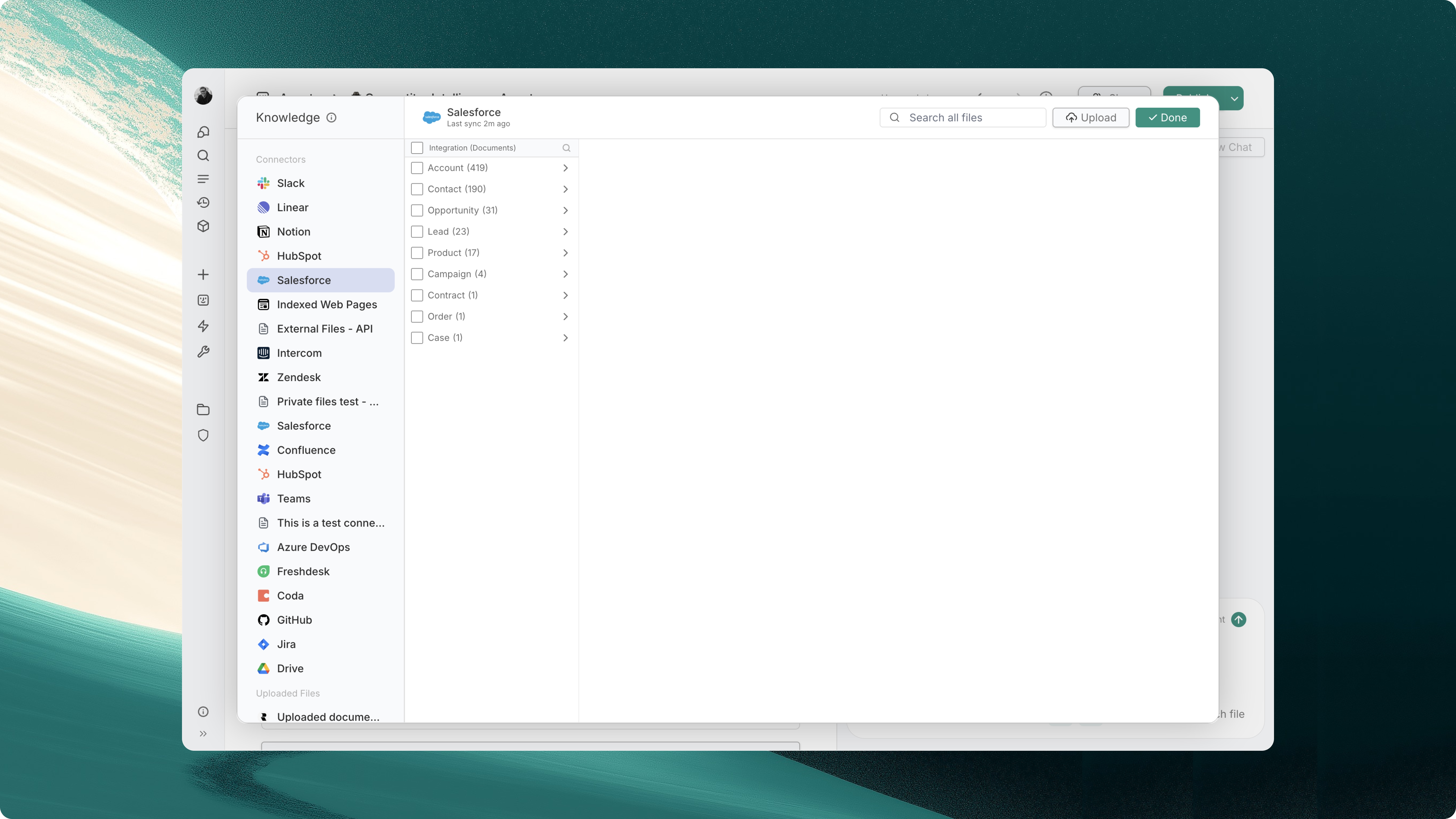
The fix: Build a single source of truth (a knowledge base that feeds AI agents for instant drafting). At Realm, we connect our AI agents directly to Confluence, Salesforce, and Google Drive so every answer is pulled from the most current, verified source.
Part 4: How to Streamline Your RFP Response Process with AI Automation
The AI-native advantage: From content library to intelligent agent
Old RFP software was a static content library. You manually tagged and uploaded past answers into a database, then searched by keyword and copy-pasted into new RFPs. The result: Maintenance-heavy, quickly outdated, and still requiring 80+ hours per response.
Modern AI-powered RFP platforms are intelligent agents. They connect directly to your existing knowledge base (Salesforce, Confluence, Google Drive, Notion) and eliminate the need for manual content library maintenance. No more tagging. No more uploading. No more outdated answers.
Realm's RFP response solution: AI agents grounded in your knowledge base
Realm transforms your company knowledge into actionable, automated agents.
The Realm difference:
- Grounded AI: Realm's agents don't hallucinate. Every response is grounded in verified company knowledge with source citations.
- No content library tax: Connect to the knowledge you already have. No need to manually upload and tag thousands of past answers.
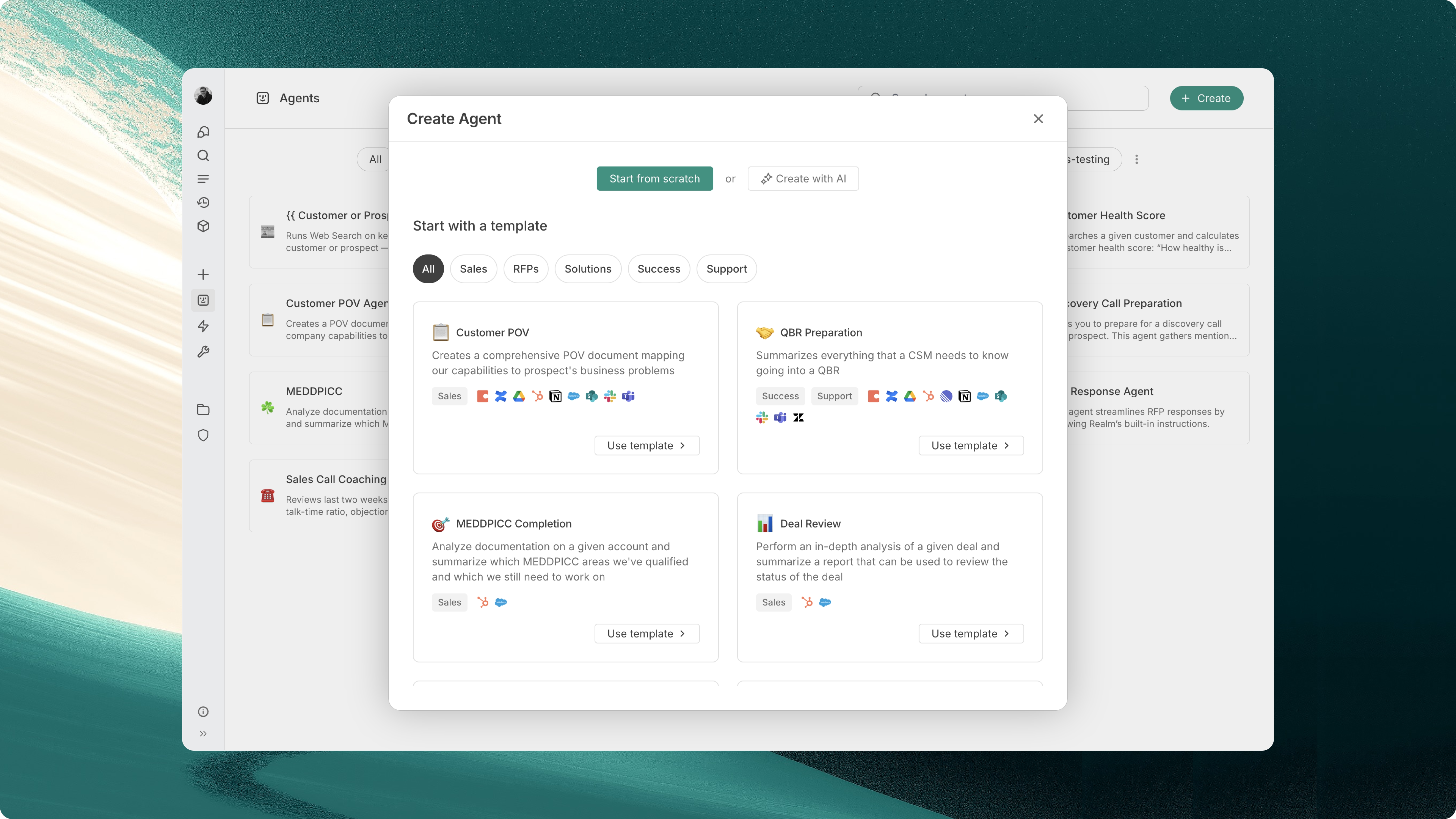
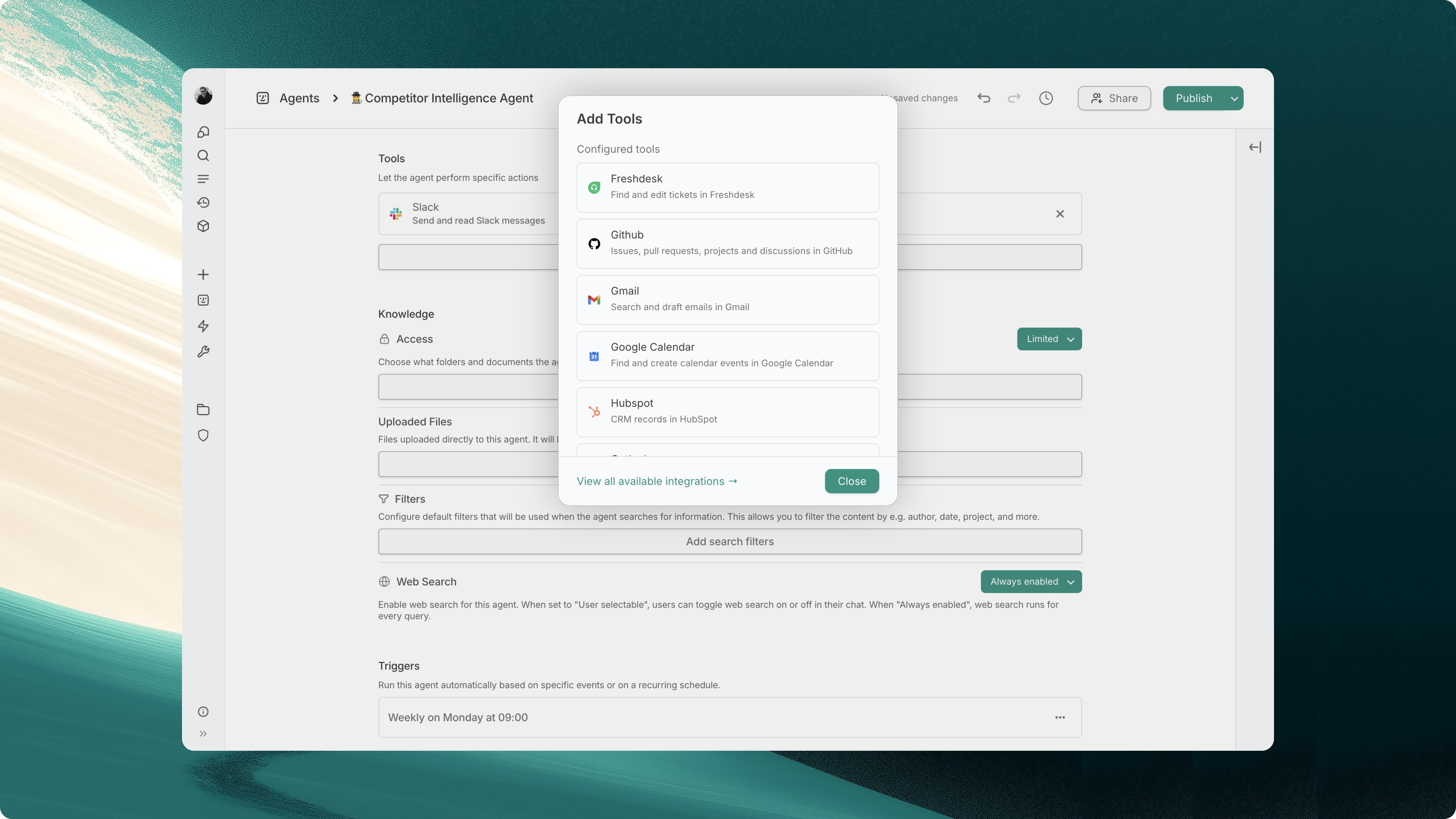
- Specialized agents: Build agents for specific use cases (e.g., Security Questionnaires, Product RFPs, Implementation Plans) to ensure specialized accuracy.
The Realm 7-step automated RFP flow (10x faster than manual)
- Upload the RFP
Drag and drop the RFP file (Excel, PDF, Word) into Realm.
- AI analysis and parsing
Realm's AI reads the document, identifies all questions, requirements, and evaluation criteria, and structures them into a project workspace.
- Choose your specialized agent
Select an agent optimized for the RFP type (e.g., "Security Questionnaire Agent" or "Product RFP Agent").
- Automated drafting
The agent drafts 80% of responses instantly, pulling from your connected knowledge base. Every answer includes source citations (e.g., "Source: Confluence - Security Overview Page"), so SMEs can quickly verify accuracy.
- Collaborate and review
SMEs review and polish the remaining 20% in a centralized workspace. Assign specific questions to team members, track status, and collaborate in real time. No more email version-control chaos.
- Export the final response
Export the completed RFP in the original format (Excel, Word, PDF), maintaining formatting and structure.
- Continuous learning (Repurpose winning content)
After submission, mark winning responses. Realm automatically indexes them back into your knowledge base, making future AI drafts even smarter.
The results: What teams achieve with Realm
- 10x faster drafting: 10 minutes vs. 60+ hours for initial drafts.
- 2x win rates: More time for strategic customization equals more compelling proposals.
- 80% reduction in SME burden: Free your experts to focus on high-value work.
- Scalability

.avif)