



Unlock efficient revenue growth
with Realm
Your customer success manager spends three days pulling data from six different systems, building a QBR deck that gets 20 minutes of attention before the client asks "So what does this mean for our renewal?" Most QBRs fail because they answer the wrong question. They report what happened instead of proving why it matters.
A quarterly business review is a strategic meeting held every three months between a vendor and client to assess performance against goals, demonstrate measurable value, and align on priorities for the next quarter. When done right, QBRs transform vendor relationships into strategic partnerships that drive retention and expansion.
This guide covers what makes QBRs effective, how to structure them for different customer lifecycle stages, step-by-step preparation timelines, common mistakes that kill engagement, and how AI automates the data work so your team can focus on strategy.
What is a quarterly business review?
A quarterly business review (QBR) is a strategic meeting held every three months to assess performance, demonstrate value, and align on goals between a vendor and client. Think of it as a checkpoint, not a status update. A real conversation about what's working, what's broken, and where you're headed together.
QBRs come in two flavors. External QBRs happen with your customers: you're proving ROI, showing progress toward their goals, and spotting expansion opportunities. Internal QBRs happen inside your company, you're measuring performance against targets, identifying blockers, and setting priorities for the next quarter.
The best QBRs aren't slide decks you present at people. They're working sessions where you prove you understand the customer's business and show how you're helping them win.
Why quarterly business reviews matter for SaaS companies
QBRs turn vendors into partners. When you run them well, you stop being "the tool we bought" and become "the team helping us hit our numbers."
Here's what happens when you get QBRs right:
- Churn drops: You catch problems in Q2 instead of discovering them during renewal conversations in Q4, critical since only 1 in 26 unhappy customers actually complain before churning
- Expansion becomes natural: When you demonstrate clear ROI, upsell conversations feel like logical next steps rather than awkward pitches
- Executive access opens up: Regular touchpoints with leadership build trust and keep you aligned when priorities shift
We've seen customer success teams that run consistent QBRs maintain net retention rates 15-20 points higher than teams relying on reactive support alone. The reason is simple: proactive engagement catches small issues before they become cancellation reasons.
QBR meaning versus executive business review
People mix up QBRs and executive business reviews (EBRs) constantly, but they're different animals.
QBRs involve the people using your product daily; account managers, team leads, project owners. You're meeting quarterly to review tactical progress like feature adoption, support resolution times, and immediate roadblocks.
EBRs involve C-level executives and happen once or twice a year. You're discussing strategic vision, competitive positioning, and how your partnership fits into their three-year plan. Think market trends and business transformation, not feature requests.
The altitude is different. QBRs operate close to the ground where you can see operational details. EBRs fly higher, focused on strategic direction and long-term alignment.
Most SaaS relationships work best with quarterly QBRs for the core team plus one or two annual EBRs with senior leadership. QBRs build trust and prove value. EBRs secure renewals and expansions, critical since expansion costs $0.61 per ACV dollar compared to $1.78 for new customer acquisition.
Types of QBRs for different stages of the customer journey

Not every QBR looks the same. The content and tone shift dramatically depending on where the customer sits in their lifecycle with you.
Onboarding QBR
The first QBR happens 60-90 days after contract signature, once implementation wraps up. This timing matters because the first 90 days determine whether a customer stays long-term. You're answering one question: "Did we deliver what we promised during the sales process?" Highlight quick wins, showcase early adoption metrics, and address friction points before they fester. This meeting also sets the baseline for future QBRs; what success looks like, how you'll measure it, and what cadence works for both teams.
Growth QBR
Mid-contract QBRs (quarters 2-3 of a 12-month deal) focus on optimization and expansion. The customer knows your product now. You're helping them extract more value. This is when you introduce advanced features, identify new use cases, and explore expansion opportunities. If they're only using your product in sales, can you expand to customer success? If they're on a lower tier, do their needs justify an upgrade?
Pre-renewal QBR
The QBR 60-90 days before contract renewal determines whether they renew, expand, or churn. Your entire focus is ROI demonstration. Quantify the business impact you delivered: cost savings, revenue generated, efficiency gains, and connect outcomes to their strategic priorities. If you've done your job in previous QBRs, this conversation feels like a formality. If you haven't, you're scrambling to justify your value.
Post-renewal QBR
Once the customer renews, the first QBR of the new contract period resets expectations and sets ambitious goals. You're celebrating what you accomplished together and mapping what's next. This is also when you introduce new product capabilities, discuss evolving needs, and confirm you're still aligned on priorities. Markets change, leadership changes, strategies change. Post-renewal QBRs keep you solving the right problems.
Who attends a QBR meeting
The wrong attendees kill QBRs. Too junior, and you can't make decisions. Too senior without context, and the meeting wastes executive time.
From the customer side, you want:
- Economic buyer or budget owner: The person who decides whether to renew and expand, they care about ROI and strategic alignment
- Day-to-day users: The people actually using your product who can speak to what's working and what's broken
- Technical stakeholders: If your product has complexity, you need IT, security, or engineering representation for integration and roadmap discussions
From the vendor side, you need:
- Account manager or customer success manager: Owns the relationship and drives the meeting
- Technical expert: Solutions engineer or product specialist who answers technical questions and discusses roadmap
- Executive sponsor: For strategic accounts, a VP or C-level from your company signals this relationship matters
The biggest mistake? Excluding the economic buyer. If the person controlling the budget isn't in the room, you're presenting to influencers, not decision-makers. This matters because churn jumps to 25% when the decision-maker leaves versus just 8% when they stay. That's fine for operational QBRs but disastrous for pre-renewal meetings.
Core agenda and metrics for a successful QBR
Strong QBRs follow a predictable structure that balances backward-looking analysis with forward-looking planning.
1. Executive summary
Start with the headline: What's the single most important thing the customer needs to know? In two or three sentences, summarize where things stand, what changed since last quarter, and what you're recommending. Busy executives will remember this slide and nothing else.
2. Goal progress and KPIs
Review the success metrics you agreed on during onboarding or the previous QBR. Show progress visually; charts and graphs communicate faster than tables of numbers. Focus on business outcomes, not product usage. Instead of "You logged 1,200 support tickets," say "Support ticket resolution time decreased by 35%, saving your team 15 hours per week."
3. ROI demonstration
Quantify value. How much money did you save them? How much revenue did you help them generate? How much time did you give back to their team? Use their language and their numbers. If the CFO cares about cost per acquisition, show how your product reduced CAC by 20%. If the VP of Sales cares about rep productivity, show how you freed up 10 hours per rep per week.
4. Challenges and opportunities
Address problems directly. If adoption is lagging in one department, acknowledge it and propose solutions. If a feature isn't delivering expected value, explain why and what you're doing to fix it. Then pivot to opportunities. Where can they get more value? Are there unused features that could solve current pain points? Are there expansion opportunities, such as new teams, new use cases, new products?
5. Next-quarter action plan
End with clear commitments. What will you do? What will they do? Who owns each action item, and when is it due? Vague commitments like "improve adoption" don't work. Specific commitments like "Train 15 sales reps on advanced features by March 15, owner: Sarah" create follow-through.
Step-by-step QBR preparation timeline
Great QBRs don't happen by accident, they require disciplined preparation.
4 weeks out
Start gathering data from usage metrics, support tickets, and business outcome tracking. Schedule the QBR and confirm attendance from key stakeholders on both sides. Reach out to your main contact and ask: "What's top of mind for your team right now? What would make this QBR valuable?" Their answer shapes your entire presentation.
2 weeks out
Analyze the data and identify the story you're telling. What's working? What's broken? What recommendations will you make? Begin building your slide deck: executive summary, goal progress, ROI sections, and action plan. Share an internal draft with your team for feedback from customer success, solutions engineering, and account management.
1 week out
Finalize your presentation and conduct an internal dry run. Practice your delivery, anticipate questions, and tighten your narrative. Send a pre-read to the customer: a one-page summary of what you'll cover and what you're recommending. This primes them for the conversation and prevents surprises during the meeting.
At Realm, we use our QBR Preparation AI Agent to automate data gathering and analysis. The agent pulls information from CRM, support systems, product analytics, email, Slack, and documentation, then generates a draft QBR deck with key insights and recommendations. Prep time drops from 8-10 hours to 1-2 hours.
Day of the meeting
Arrive early if in-person or log in five minutes early if virtual. Start on time;respecting executive calendars builds trust. Facilitate, don't present. Ask questions, invite feedback, and make it a dialogue. The best QBRs feel like collaborative working sessions, not one-way presentations.
Post-QBR follow-up
Within 24 hours, send a summary email with key takeaways, agreed-upon action items, and next steps. Include owners and due dates for every commitment. Schedule any follow-up meetings immediately; training sessions, technical deep dives, or check-ins. Get them on the calendar before momentum fades.
Best practices to run an engaging QBR
Execution separates mediocre QBRs from exceptional ones.
Personalize with customer goals
Generic QBRs feel like vendor spam. Every slide, every metric, every recommendation ties back to the customer's specific business objectives. If they told you during kickoff that reducing customer churn is their top priority, every section of your QBR connects to that goal. Show how your product impacts churn, what additional features could reduce it further, and what you're seeing from similar customers.
Lead with insights not data dumps
Nobody cares that they logged 847 support tickets last quarter. They care that ticket volume increased 23% because they launched a new product without adequate training. Transform raw data into actionable insights. Every chart needs a "so what?" If you can't explain why a metric matters and what the customer can do about it, cut it from the presentation.
Invite the economic buyer early
The biggest QBR mistake is waiting until the pre-renewal meeting to involve the budget owner. By then, it's too late to build a relationship. Invite the economic buyer to at least one mid-contract QBR, ideally the Q2 or Q3 meeting. Frame it as a strategic check-in: "We'd love 30 minutes with your CFO to confirm we're aligned on priorities and delivering value against your key initiatives."
Keep it under 15 slides
Long decks signal you don't know what matters. Ruthlessly cut anything that doesn't directly support your narrative. Aim for 10-12 slides for a 60-minute QBR. That leaves time for discussion, questions, and collaborative problem-solving.
End with clear owners and dates
Meetings without accountability are just conversations. Every action item needs an owner and a deadline. Don't say "We'll explore that." Say "Sarah will send you three case studies of similar implementations by Friday." Don't say "Let's schedule training." Say "We'll conduct advanced features training for your sales team on March 15 at 2 PM ET"
Common QBR mistakes and how to avoid them
Even experienced customer success teams make predictable mistakes.
Focusing on product usage not business impact
Showing feature adoption metrics without connecting them to business outcomes loses executive attention fast. Nobody renews because they used 15 features, they renew because those features delivered measurable value. Always translate usage into impact. Instead of "80% of your team uses our reporting dashboard," say "Your team's reporting time decreased from 5 hours to 30 minutes per week, freeing up 4.5 hours per person for strategic analysis."
Overloading with vanity metrics
Vanity metrics look impressive but don't drive decisions. "You sent 10,000 emails through our platform" means nothing. "Your email campaign generated 250 qualified leads worth $1.2M in pipeline" means everything.
Focus on metrics tied to the customer's goals:
- Revenue: Show revenue impact if that's what they care about
- Efficiency: Show time savings if that's their priority
- Risk: Show incidents prevented if that drives their decisions
Skipping executive context
Diving straight into operational details without framing business context loses your audience. Executives think in terms of strategic priorities, market dynamics, and competitive positioning, not feature lists. Start every QBR by connecting your work to their current business priorities. "You mentioned in our last meeting that expanding into enterprise accounts was a top priority. Here's how our platform supported that goal last quarter."
Neglecting follow-up actions
The QBR meeting is only half the work. Execution on commitments is the other half. If you promise to deliver training, introduce a product specialist, or investigate a technical issue, then don't follow through, you damage trust. Build a follow-up system using a shared document or project management tool to track commitments, assign owners, and set reminders. Review open action items at the start of each QBR to demonstrate accountability.
How to scale QBRs across hundreds of accounts
As your customer base grows, maintaining QBR quality becomes a resource challenge. You can't spend 10 hours preparing for every meeting when you're managing 200 accounts. The solution is segmentation and automation. Not every customer needs the same level of QBR rigor.
- Tier 1 accounts: Enterprise, high ARR, strategic customers get fully customized QBRs with executive participation and deep analysis
- Tier 2 accounts: Mid-market, moderate ARR customers get semi-customized QBRs using templates with personalized sections
- Tier 3 accounts: SMB, lower ARR customers get automated QBRs; data-driven reports with minimal customization, sometimes as interactive dashboards rather than live meetings
Technology is how you scale without sacrificing quality. Customer success platforms, business intelligence tools, and AI-powered solutions automate data collection, generate insights, and draft presentation decks, freeing your team to focus on strategy and relationship-building rather than data wrangling.
Automating QBR preparation with AI
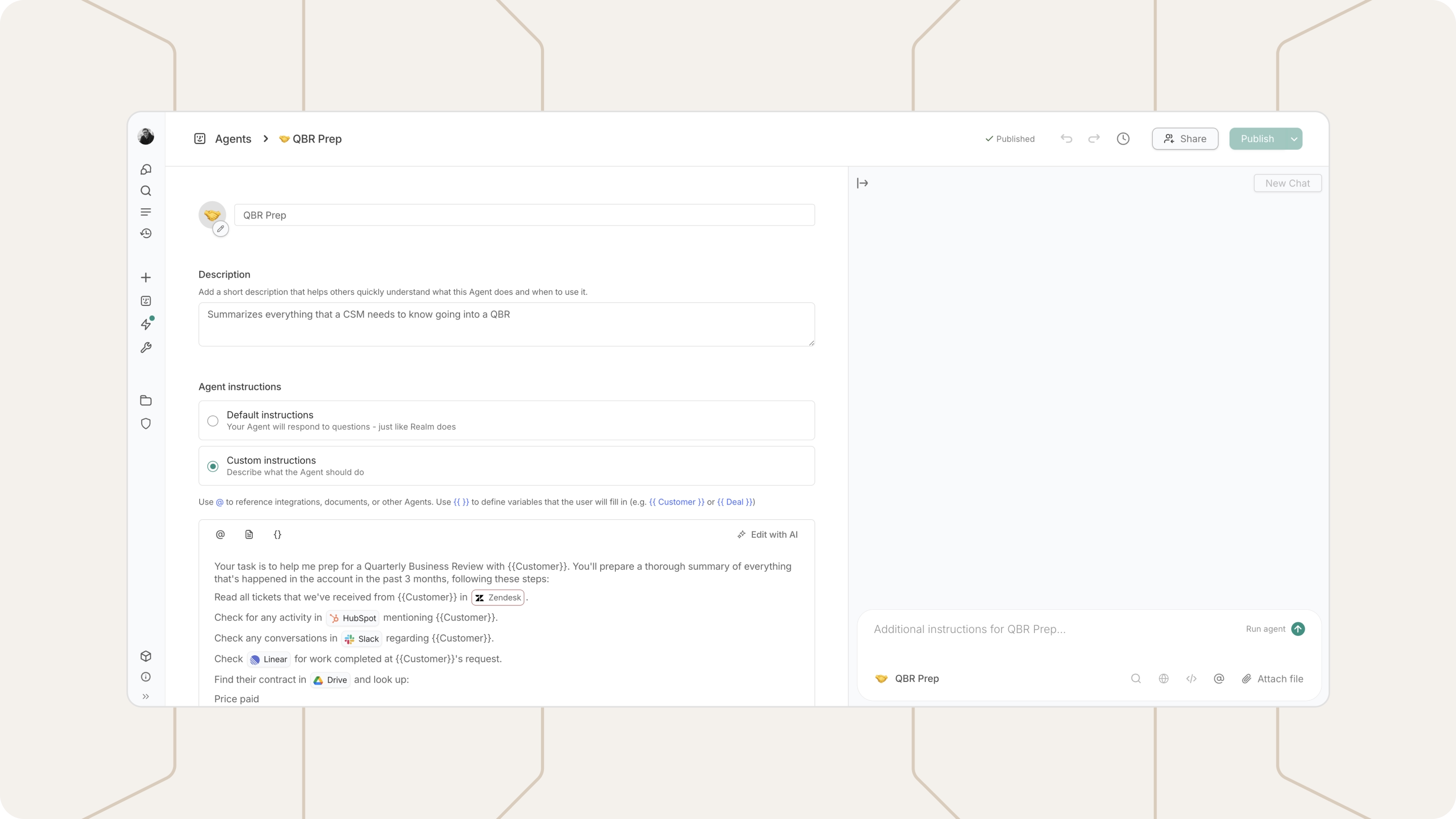
Manual QBR preparation is a time sink. Gathering data from CRM, support systems, product analytics, and communication tools takes 6-8 hours per account. Analyzing that data and building a coherent narrative takes another 2-3 hours.
AI changes the economics of QBR preparation by automating the grunt work. Realm's QBR Preparation AI Agent handles this by:
- Aggregating data automatically: Pulls information from Salesforce, support tickets, product usage analytics, email, Slack, and documentation
- Generating insights: Identifies trends, flags risks, and surfaces opportunities based on customer behavior and engagement patterns
- Creating draft decks: Builds a structured QBR presentation with executive summary, goal progress, ROI analysis, and recommended actions
- Personalizing content: Tailors messaging to the customer's industry, goals, and current priorities
- Maintaining consistency: Confirms every QBR follows best practices and covers all critical element
QBR preparation time drops from 8-10 hours to 1-2 hours. Your team reviews the AI-generated draft, adds qualitative context and relationship insights, and customizes the narrative, but the heavy lifting of data gathering and initial analysis is automated.
This matters because it lets customer success teams scale without hiring proportionally. A CSM managing 40 accounts can maintain QBR quality across their entire portfolio rather than cherry-picking which customers get attention.